The hybrid workforce is already here

Why the first useful agent in a company isn't the one that acts on the world. It's the one that makes it legible.

Apr 21, 2026


I think most writing about AI at work still makes the same mistake. It starts where the drama is. Autonomous agents. Fully automated teams.

That is not where the change starts. The change starts one layer earlier. It starts in the layer between raw information and human judgement.

Once I began building with agents properly, that became the most obvious thing in the world. The first useful agent in a company is rarely the one that acts on the world. It is the one that makes the world legible before a human has to act.

That sounds smaller than it is. In practice, a lot of work begins with reconstruction. You come in, reopen Slack, scan three threads, re-read a doc, remember what changed, and only then figure out what your actual decision is. The cost is not just time. The cost is fragmentation. That is why the early value of agents feels less like automation and more like ambient context.

This is also where the best public guidance is unexpectedly grounded. OpenAI recommends starting with a single agent, strong tools, guardrails, and human intervention for failure thresholds and high-risk actions. Anthropic makes the same point from a different angle: workflows and agents are different things, the best systems often use simple composable patterns, and you should look for the simplest solution first. Both are essentially saying: build for guardrails and human judgment. That's exactly right—because your agent's job is to make things legible, not to replace the person making the call.

That matches what I’ve learnt while building agents grounds up. No, not adopting open source projects but re-imagining and building enterprise grade agents.

The first systems that people trust are not the systems that try to look magical. They are the systems that are useful by 9am.

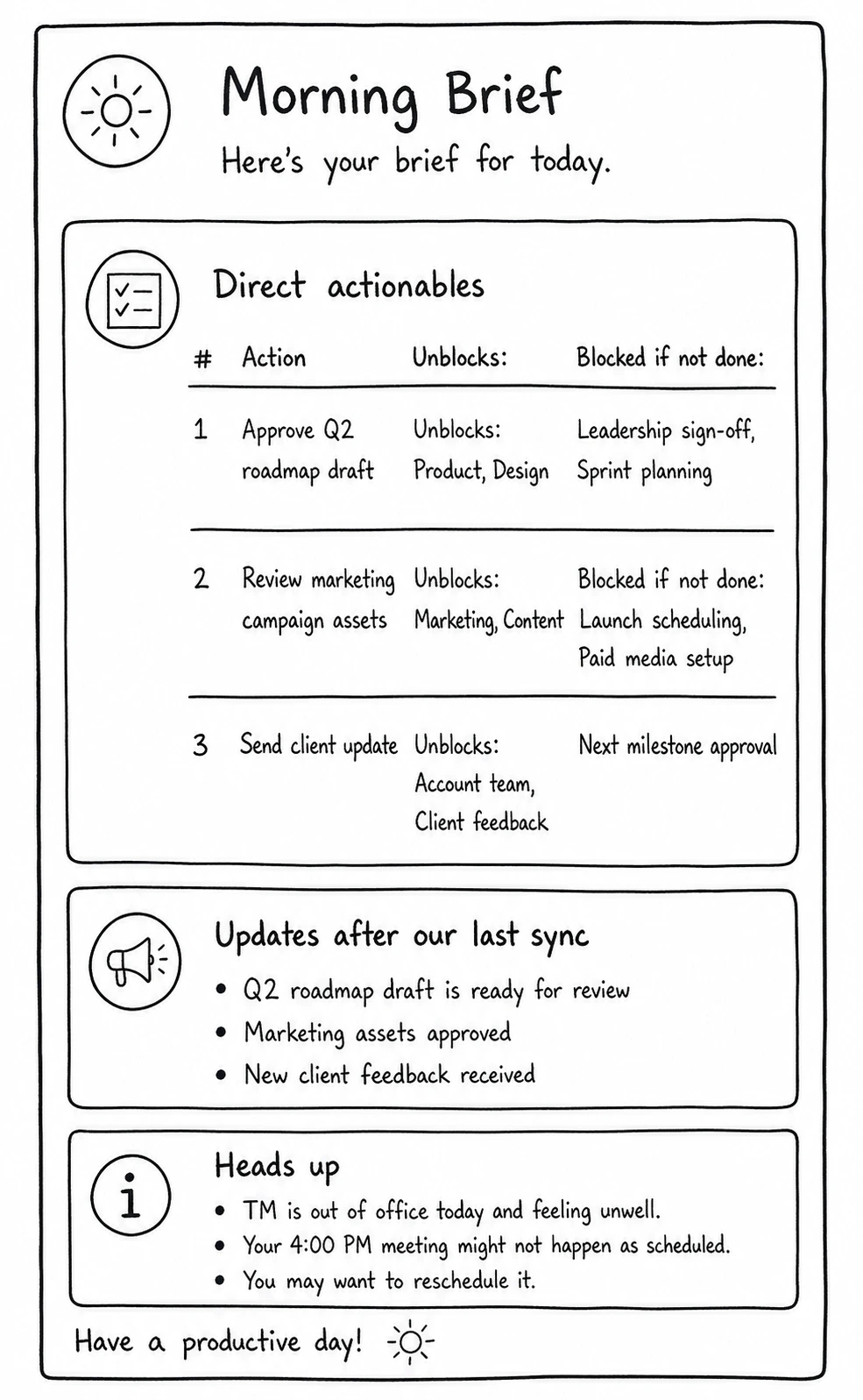
summary report doodle

A good example is the “already know what matters” feeling. That is where the workday changes. You open your brief and it tells you four things: what changed, what needs your judgement, what is about to break, and what can safely wait. The work is still mine. The overhead is not.

The pattern is visible in mainstream work products. Slack’s AI features now include recaps and daily summaries for unread channels. Notion’s AI meeting notes capture calls, generate summaries, and pull out action items. Intercom’s Procedures product shows the same idea on the execution side: natural-language instructions combined with deterministic controls for bounded support flows. Those are not side features. They are evidence that the “context layer” is already becoming a standard part of work software.

The second change is the blank page.

Most people do not delay important writing because they have no thoughts. They delay it because starting is expensive. That is why I now think the biggest practical shift is not that the model finishes the work. It is that it gets me out of zero. The best prompt output is not the final answer. It is a draft sharp enough for me to react to.

There's evidence. In customer support, AI guidance improved average productivity and helped less-experienced workers much more than top performers. In software development, controlled rollouts show measurable gains in completed tasks as well. That is exactly what I would expect if the model is strongest as a context-and-first-draft engine and weaker as a substitute for judgement on ambiguous, high-stakes work.

So, this is the frame I would use: hybrid is not a transitional state; it is the operating model. We keep expecting it to be temporary because the narrative pressure is always toward full automation. But the systems I see actually winning are the ones that accept that humans stay in the loop.

For what I am observing while building and using enterprise agents, humans will retain the right to make consequential calls, hold deep social context than textual, manage relationships, and decide what matters when the trade-offs are real. Agents may take on the work that is mostly reconstruction, retrieval, first drafts, bounded execution, and follow-through.

That is the version of the future of work I find believable because it is already showing up in boring, useful ways.

And boring, useful systems usually win.


A Personal Blog by Tushar Mohan.
Sharing key lessons and insights from experiences in engineering, product development, and team building. Views expressed are personal and based on my experiences.© 2026